

| Chinatown - History |  |
 |
 |
|
Los Angeles Chinatown (Chinese: 洛杉磯唐人街; pinyin: luò shān jī táng rén jiē) is an historic ethnic neighborhood, which has historically served as a port of entry for its waves of immigrants of diverse national origins throughout its more than 160-year history. The first Chinese was recorded in Los Angeles in 1852. By 1870, an identifiable "Chinatown" was situated on Calle de Los Negros - a short alley 50 feet wide and one block long between El Pueblo Plaza and Old Arcadia Street. A 1931 Supreme Court ruling approved condemnation of Old Chinatown to allow for the construction of Union Station and resulted in Chinatown’s relocation. In 1933, the City forcibly evicted the residents and razed “Old Chinatown” to build Union Station, which then resulted in the 1938 relocation of the Chinese to “New Chinatown,” today’s Central and West Plazas and heart of Chinatown’s historic core. Today, College Street provides a rough boundary between the older (post-1930s and 1940s) and newer businesses (post-1980s). Many businesses belonging to the original American-born Chinese families (Taishanese and Cantonese Chinese) are in the northwest area, which is now Chinatown’s historic core. In the southeast, first-generation Southeast Asian immigrants and refugees of Chinese origin own the businesses, many of whom run small curiosity shops and bazaars in the shopping plazas such as Saigon Plaza and Dynasty Center—both built in the 1980s—south of Broadway. Today these immigrants and their families own nearly 90 percent of Chinatown's businesses. Chinatown’s current population is predominantly comprised of Asians (Chinese, Vietnamese, Laotians, and Cambodians, being the dominant subgroups) and Latinos. June 28th, 2013, will mark the 75th Anniversary of the “Grand Opening of New Chinatown,” the only Chinese community in America which was planned beforehand, and what is now our historic Central and West Plazas. Over the past dozen years, the community and the City of Los Angeles have expanded Chinatown’s cultural heritage preservation efforts through the design and completion of the several public-private partnership projects between city agencies and Chinatown community organizations to revitalize this unique and vibrant neighborhood as a regional historic and cultural destination place.
Chinatown Angels Walk – Joint City-community project consisting of 16 7-foot high, 2-foot-wide stanchions in locations throughout Chinatown that provide a self-guided walking trail commemorating the community’s history, architecture and culture and accompanying Angels Walk guide book developed by the Chinatown Business Improvement District (BID).
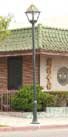
North Broadway Streetscape Enhancements – 88 new Hong Kong Orchid trees and installation of 92 Chinese themed pedestrian and historical street lights by Chinatown BID and City, and the implementation of the Chinatown Gold Line Pedestrian Linkages Project which continued the North Broadway Streetscape throughout Chinatown’s commercial corridors and included additional enhancements promoting the Chinese culture through theme designed crosswalks, tree wells and street benches.
|
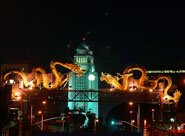 The Chinatown Gateway Monument built and funded jointly by the City of Los Angeles, Community Redevelopment Agency of Los Angeles (CRA-LA), the Los Angeles County Metropolitan Transit Agency, and Chinatown’s numerous Family Associations, community organizations and individual Chinatown donors.
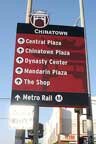 Chinatown’s “LA Walks” Wayfinding Pedestrian Signage is another City of Los Angeles and CRA-LA project in cooperation with Chinatown BID to assist visitors and residents as they travel and explore Chinatown’s restaurants, shops and historic cultural venues.
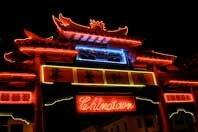 Preservation efforts by Chinatown BID, Chinese Historical Society of Southern California and others resulted in 2005 designations of “New Chinatown’s Western Gate and Eastern Gate as City of Los Angeles Cultural Monuments Nos. 825 and 826 – Chinatown’s oldest pailou, the West Gate is made partially of 150-year-old camphor wood.
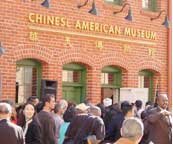 The Chinese American Museum is located in the Garnier Building inside El Pueblo Monument, a 44-acre state historic park; it is the first such museum in Southern California dedicated to the Chinese American experience and history in this region. The Garnier Building is the last of the oldest buildings of “Old Chinatown” that was exclusively and continuously inhabited by Chinese immigrants from the time of its construction in 1890 and is listed in the National Register of Historic Places as part of the Los Angeles Plaza Historic District. The Museum is jointly developed and operated by the Friends of the Chinese American Museum (FCAM) and El Pueblo de Los Angeles Historical Monument (El Pueblo), a department of the City of Los Angeles.